
Today, typing a URL feels natural — a word, a dot, an extension, and you’re connected instantly. But behind this simplicity is a layered history that stretches back to the 1960s, when the first networks were being born. Understanding this evolution is not just a technical curiosity — it explains why .com became the world’s digital default and why the secondary domain market exists at all.
From ARPANET to Hostnames
- 1969: ARPANET, the ancestor of the internet, went live connecting four U.S. research institutions.
- Early addressing was numeric, using IP-like identifiers (e.g., 10.0.0.1).
- By the early 1970s, the Hosts.txt file was introduced — a manually updated text file listing all known computers and their names. Every node had to download the latest version to communicate with others.
- As the network grew, this system became unmanageable. By the 1980s, there were thousands of hosts — and the idea of a scalable naming system became urgent.
The Birth of the Domain Name System (DNS)
- 1983: Paul Mockapetris at USC’s Information Sciences Institute proposed and implemented the Domain Name System (DNS).
- Instead of relying on a central text file, DNS created a hierarchical, distributed database of names and addresses.
- DNS introduced the concept of top-level domains (TLDs): .com, .org, .net, .gov, .mil, and .edu.
1985: The Introduction of .com and Other Extensions
- January 1, 1985: The first domains using this new system were registered.
- The original TLDs each had a purpose:
- .com → Commercial organizations
- .net → Network providers and infrastructure
- .org → Non-profits and organizations
- .edu → Educational institutions
- .gov → U.S. government
- .mil → U.S. military
Why .com? The U.S. Department of Defense (which funded ARPANET) wanted to keep .mil exclusive for the military, while giving commercial entities their own category. The job of operating .com was given to Symbolics Inc., a computer company that registered symbolics.com on March 15, 1985 — the first .com domain in history.
Who Initiated It?
- The DNS was designed by Paul Mockapetris in 1983.
- The first TLDs were overseen by Jon Postel, a legendary figure in internet history, who managed the “Internet Assigned Numbers Authority” (IANA).
- Registration was initially handled by the Defense Data Network under government contract.
- By the 1990s, responsibility moved to Network Solutions, and later ICANN (founded in 1998).
The Explosion of .com
- At first, domain registration was free — companies registered only for technical use.
- By the mid-1990s, the World Wide Web created a gold rush. Businesses realized a .com domain was their storefront in the digital economy.
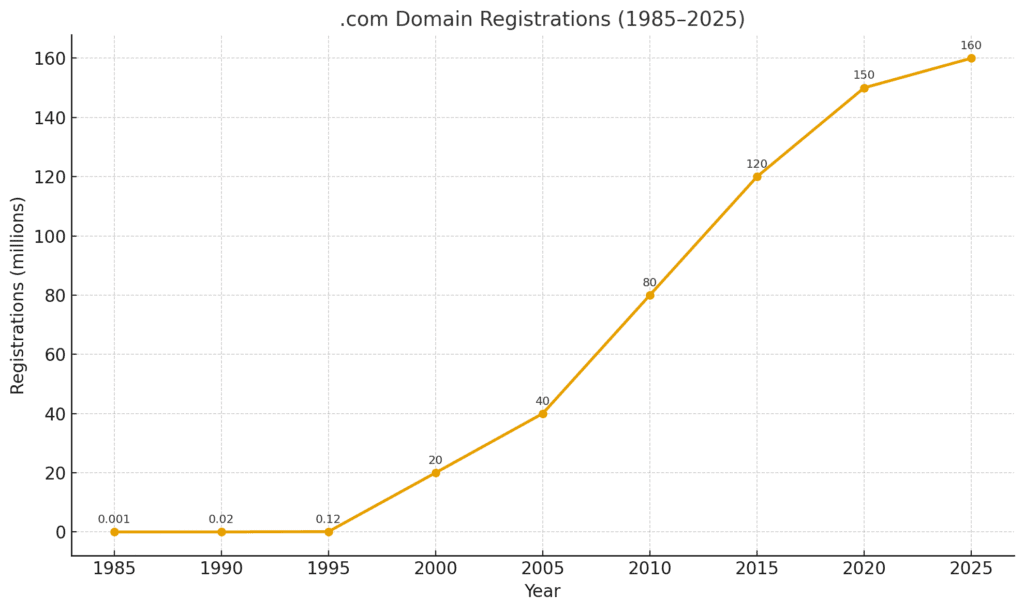
- By 1997, there were over 1 million registered .coms.
- By 2000, more than 20 million. Today, over 160 million .coms exist — making it the single most valuable namespace on the internet.
Why This Change Mattered
The shift from numeric IPs and Hosts.txt to human-readable domains was more than convenience. It:
- Made the internet usable by ordinary people.
- Created the foundation for brands, identity, and digital real estate.
- Turned domain names into assets with psychological, linguistic, and economic power.
Without DNS and .com, there would be no secondary domain market today.
Timeline at a Glance
| Year | Milestone | Notes |
|---|---|---|
| 1969 | ARPANET goes live | First 4 nodes connected |
| 1971 | Hosts.txt file | Central text file for hostnames |
| 1983 | DNS introduced | Paul Mockapetris designs system |
| 1985 | .com, .org, .net, .edu, .gov, .mil | First domains registered |
| 1985 | Symbolics.com | First .com domain |
| 1990s | WWW + commercial growth | .com boom begins |
| 1998 | ICANN founded | Global coordination of domains |
| 2025 | 160M+ .coms | Still the gold standard |
Conclusion
The history of URLs is a story of simplicity built on complexity. What began as a way to connect scientists through ARPANET evolved into a global naming system that gave us .com — a digital marker now synonymous with legitimacy, authority, and value.
Every time a domain sells for six or seven figures, it’s worth remembering: this entire market exists because of a decision in the 1980s to move from numbers to words, from Hosts.txt to DNS, from technical identifiers to human meaning.