Introduction: Digital Identity in the Age of Dependence
We live in an age of profound contradiction. Never has it been easier for individuals and companies to establish a digital presence — a social media profile, a marketplace storefront, an app listing. Yet never has this presence been more fragile. A single policy change, algorithm shift, or account suspension can erase years of effort.
This is where domains stand apart. A premium domain name is more than a marketing tool or investment. It is a sovereign digital property right — a plot of land in cyberspace that you own outright, governed by global registries and contracts, not the whims of any one corporation.
This article argues that domains must be understood not only in terms of ROI or branding, but as the core infrastructure of digital sovereignty. Over the next 30 years, as the world faces geopolitical fragmentation, AI disruption, and centralizing control over platforms, domains will become the most reliable form of digital independence.
1. The Fragility of Rented Identity
Before we explore sovereignty, it’s worth contrasting it with dependence. Most online identities today are “rented”:
- Social media handles: Your username exists only at the pleasure of the platform. Twitter (now X) bans accounts daily. Instagram can shadow-ban or deplatform with little recourse.
- App stores: Apple or Google can delist your app. Without distribution, your product vanishes overnight.
- Marketplaces: Sellers on Amazon or Etsy rely on algorithmic placement. A policy violation can destroy income streams.
All of these “digital properties” are, in truth, digital tenancies. You are leasing visibility on someone else’s land. You own none of the rails.
By contrast, a domain name is freehold property. As long as you renew it, it is yours. It is not subject to sudden deplatforming or corporate policy changes. Even if a registrar folds, ICANN rules ensure continuity. This durability is what makes domains unique among digital assets.
2. Historical Parallels: From Land to Trademarks to Domains
To see domains as sovereignty, consider the history of property rights.
- Land ownership was the foundation of feudal and later capitalist economies. Control of land meant control of agriculture, wealth, and military power.
- Trademarks and brands emerged in the industrial age. A trademark was not just legal protection; it was economic sovereignty in the marketplace. Coca-Cola, Nike, and Rolex thrive because of their legally protected brands.
- Domains are the third evolution. In the digital age, they are simultaneously land (scarce plots of real estate), trademark (identity), and infrastructure (your home on the internet).
Just as land titles and trademark registrations became central to sovereignty in earlier centuries, domain names are becoming the deeds of the digital era.
3. The Anatomy of Digital Sovereignty
Sovereignty in the digital world has three components:
- Control of access: You decide who enters, how they interact, what information is shared.
- Immunity from unilateral takedown: No single platform can erase your existence.
- Transferable property rights: You can buy, sell, lease, or pass it on to heirs — like any valuable asset.
Domains fulfill all three. They are not merely technical identifiers but portable, legally recognized rights across jurisdictions. When you own a domain, you command a sovereign address in the global namespace.
4. Case Study: Platform Dependence vs. Domain Independence
Imagine two startups:
- Startup A builds its entire brand on Instagram. It grows to 500K followers. Then one day, the account is flagged for “suspicious activity” due to a competitor’s false reports. After weeks of appeals, the account is gone. Years of community vanish.
- Startup B builds its brand on GreenHarvest.com. Its Instagram, TikTok, and YouTube channels all drive traffic back to this domain. Even if accounts are deleted, the domain persists. Customers can always type the name directly.
The difference? Startup A was a tenant. Startup B was a sovereign.
5. The Economics of Sovereignty
The power of domains as sovereignty is not only philosophical; it is economic.
Lower Risk Premium
Investors and acquirers value certainty. A brand built on MyApp.io carries platform risk. One built on App.com does not. This certainty expands multiples in M&A.
Durable Moats
Social media visibility is fleeting. Domains accumulate backlinks, type-in traffic, and search authority. These compounding assets are hard to replicate once lost.
Intergenerational Transfer
Unlike social media handles, a domain can be willed to heirs. It becomes part of a family office portfolio, like real estate or fine art.
6. Domains and Geopolitical Fragmentation
We are entering an era of geopolitical fracture:
- Countries assert digital sovereignty (e.g., China’s firewall, Russia’s national internet initiatives).
- Platforms align with governments, enforcing censorship or bans.
- Payment rails become politicized.
In this world, domains become neutral ground. They are administered by global registries and secured by ICANN. While local laws can restrict websites, the ownership of the root domain remains transnational. It is harder to confiscate than a social handle. For businesses in volatile regions, this property right can mean survival.
7. Domains and Artificial Intelligence
AI adds another dimension. As AI agents interact, domains become anchors of trust.
- If you receive an email from WealthAxia.com, you trust it more than from wealth-axia123@gmail.com.
- AI systems themselves will rely on domains to authenticate sources. A bot scraping HealthSecure.com vs. HealthTipsBlog.net will prioritize authority.
Thus, domains will become the trust rails for AI-to-human and AI-to-AI communication. Sovereignty here is not abstract — it is the infrastructure of machine-readable authority.
8. Counterarguments and Rebuttals
“Domains are less important now; everyone uses apps.”
Apps still depend on domains for email, SEO, and verification. Most app traffic originates from web discovery.
“New gTLDs dilute sovereignty.”
While true that new extensions multiply options, scarcity of meaning remains. Owning the exact .com or respected ccTLD is still sovereign ground.
“Web3 will replace domains with blockchain addresses.”
Blockchain names (ENS, Unstoppable Domains) may complement but not replace the DNS root. ICANN-governed domains remain globally interoperable and recognized in legal systems.
9. Comparative Table: Rented vs. Owned Digital Identity
| Feature | Social Media Handle | App Store Listing | Marketplace Store | Domain Name |
|---|---|---|---|---|
| Ownership | Platform-controlled | Platform-controlled | Platform-controlled | User-owned |
| Transferability | No | No | No | Yes |
| Susceptible to bans | High | High | High | Low |
| Asset longevity | None | None | None | Indefinite |
| Intergenerational transfer | No | No | No | Yes |
| Role in AI trust | Minimal | Minimal | Minimal | Critical |
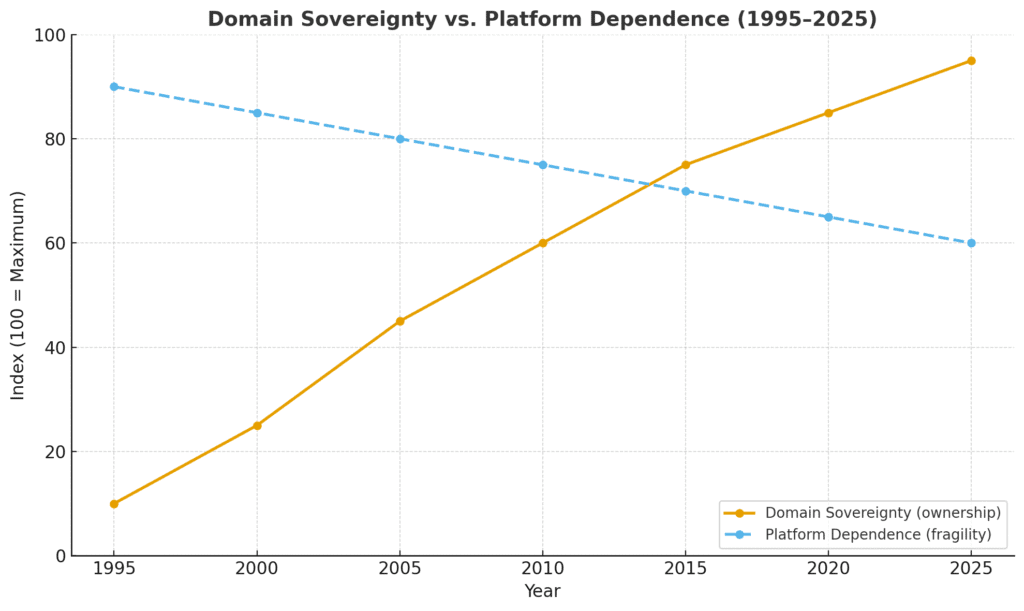
10. Graph: Growth of Domain Sovereignty vs. Platform Dependence (1995–2025)
11. Future Scenarios (2025–2040)
- Digital Citizenship: Domains tied to verified digital IDs, functioning as passports.
- AI Governance: AI will trust domains as primary identifiers for legitimate actors.
- Resilient Business Models: Companies reliant solely on platforms will remain fragile; those anchored in premium domains will weather crises.
- Securitization of Domains: Fractional ownership and funds treating domains like real estate REITs.
Conclusion: The Imperative of Digital Sovereignty
Domains are not dead relics of the 1990s. They are the bedrock of digital sovereignty. In an era where platforms rise and fall, regulations tighten, and AI blurs the boundary between human and machine communication, the one durable, portable, transferable property right online is your domain name.
To own a premium domain is to own your place in the digital world — not rent it. That is sovereignty, and in the decades ahead, it will be priceless.