
For a long time, domains were treated like a technical detail—something you grabbed at the end of a branding project, like printing business cards after you’ve already chosen the company name.
That era is over.
Domains are not merchandise. They are infrastructure—a naming layer that sits beneath commerce, identity, reputation, distribution, and trust. A domain is the simplest “address” a human mind can carry and repeat without friction. And friction is the hidden tax on every serious business.
If you want to understand where the domain market is heading, you have to stop staring at individual sales headlines and start looking at the system-level reality:
- how many domains exist,
- how fast that number changes,
- and how strongly incumbency (renewal, continuation) dominates the landscape.
That’s what the data reveals—quietly, but unmistakably.
Graph 1: The Naming Layer Keeps Expanding
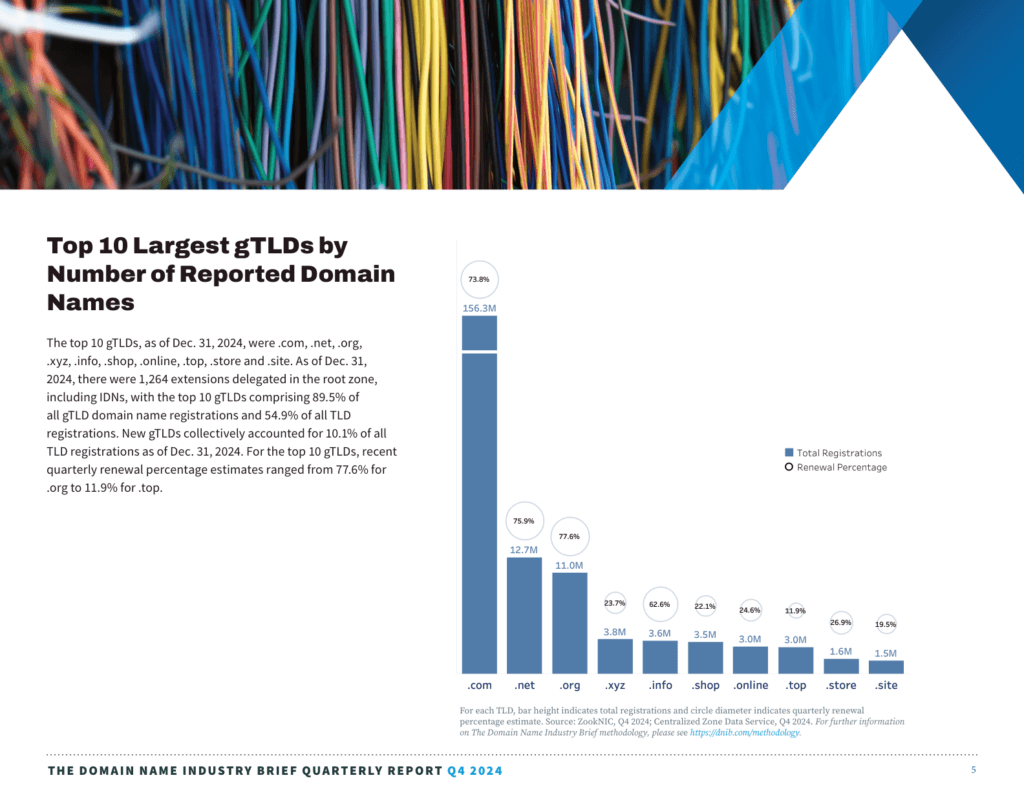
(“Total domain name registrations across all TLDs” – Verisign DNIB Q4 2024.)
This isn’t a “domain investor graph.” This is a civilization graph.
Verisign’s DNIB reports that Q4 2024 closed with 364.3 million domain registrations across all TLDs.
Pause on the number: hundreds of millions of registered names.
Even if you dislike modernity, the implication remains the same:
the digital world keeps creating entities that need names. Projects, products, communities, startups, media properties, campaigns, movements, pseudonymous identities, side-hustles, micro-brands—everything that wants continuity or credibility ends up wanting a stable naming anchor.
And this matters because scarcity in domains is not just about how many names exist—it’s about how many names are already taken, already renewed, and therefore already defended by inertia.
The growth of registrations creates a subtle effect that most casual observers miss:
The longer the system runs, the harder it becomes to find short, clean, intuitive names that aren’t already owned.
That is not speculation. That is mathematics applied to language.
The Real Market Isn’t “Domains.” It’s Continuity.
A common misunderstanding is that the domain market is driven by “new registrations” the way social media is driven by “new sign-ups.”
That’s not how naming systems work.
Naming systems are dominated by continuation—people and organizations keeping what they already have because:
- they’ve already built links and trust,
- they’ve already printed it everywhere,
- they’ve already trained people to remember it,
- and switching costs are real (even if not acknowledged).
This is why renewals matter at least as much as registrations: renewal behavior is a proxy for commitment.
If renewal rates collapse, the space becomes a churn-farm.
If renewal rates persist, the space becomes an accumulated archive of defended identity.
And that brings us to the next graph.
Graph 2: .com Still Sits at the Center of the Naming Layer
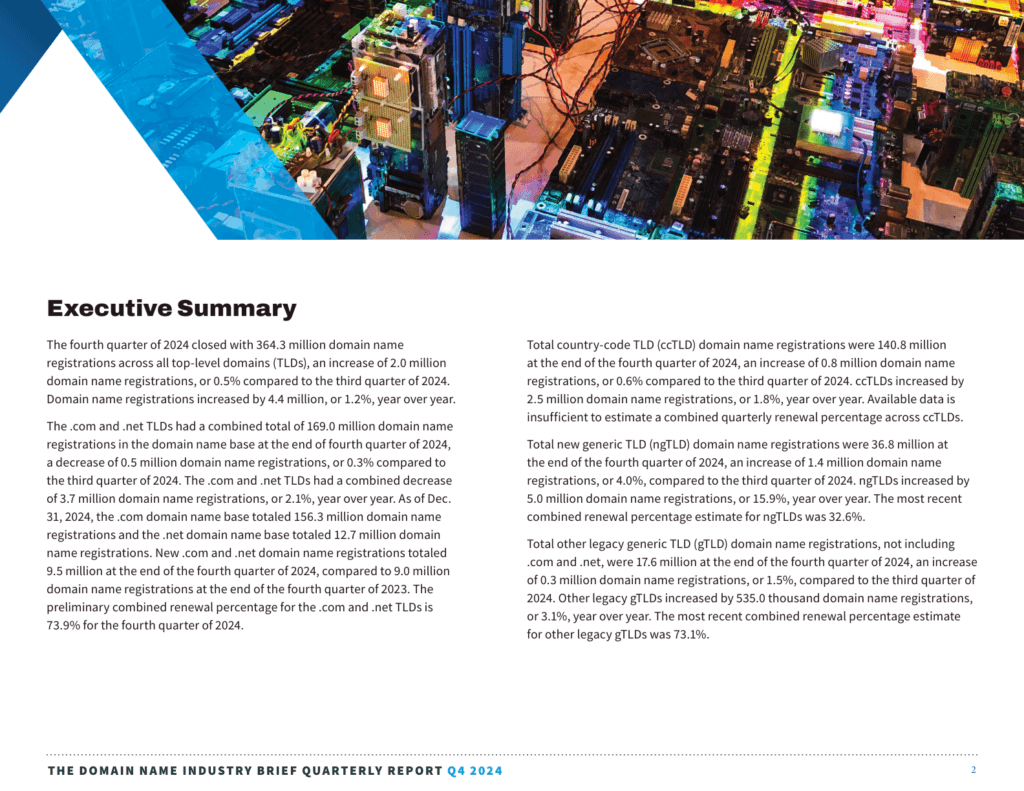
(Top gTLD registrations + renewal estimates – Verisign DNIB Q4 2024.)
Look at the ranking and scale.
In the DNIB Q4 2024 snapshot, .com sits around 156.3M registrations—by far the gravitational center among gTLDs.
This matters for premium domains for a simple reason:
Premium domain value is not created by “availability.” It’s created by shared human default behavior.
People default to .com.
They type it, assume it, remember it, and trust it—especially in international business.
Yes, alternatives exist. Yes, some brands successfully operate on other extensions. But at the system level, the default remains the default, and defaults create price floors in the premium tier.
Even more important: the DNIB also provides renewal percentage estimates for major TLDs (where available).
Renewal is the “hidden vote” people cast for the naming system they’ve chosen.
And the market reality is this:
- many people register domains impulsively,
- far fewer renew domains for years,
- and only a fraction build a real brand asset on top of them.
So when you see persistent scale plus meaningful renewals, you’re seeing the structural base that premium domains sit on.
Why This Supports Premium Domains Without Needing Hype
Most domain sales pitches are shallow. They rely on “branding” buzzwords, or on cherry-picked sales that make the market look like a casino.
But the real case for premium domains is quieter:
- The naming layer keeps growing. (Graph 1)
- The default naming anchor remains .com at overwhelming scale. (Graph 2)
- The longer the system runs, the more the best names become locked away—not by “investors,” but by businesses and builders who simply don’t let go.
Premium domains are not a fad asset class. They are a form of compressed advantage:
- less friction,
- fewer misdirects,
- faster recall,
- and stronger trust transfer.
Not magical. Not guaranteed. But real.
The Underestimated Truth: Domains Become More Valuable in an Age of Synthetic Noise
We are entering an era where content can be generated endlessly, cheaply, and convincingly.
That changes the value of anchors.
When everything becomes easy to fake—text, images, video, even voice—people gravitate toward stable reference points. A domain is one of the simplest stable reference points: a durable handle for reputation.
In that environment:
- a clean name becomes a trust shortcut,
- a confusing name becomes a tax,
- and a compromised name becomes a vulnerability.
So the premium domain case strengthens not because “domains are trendy,” but because the world is becoming noisier, faster, and less trustworthy.
And the human mind responds to that the way it always has:
It reaches for what is simple, stable, and memorable.
What You Should Take From This (Without Marketing Spin)
- The domain system is not shrinking. It is still expanding at massive scale.
- .com remains the central reference point in the global naming layer.
- Renewal behavior and persistence matter more than hype, because they represent continuity—where value actually accumulates.
If you’re building something meant to last, you don’t want a name that feels temporary.
And the more temporary the surrounding world becomes, the more that matters.